Online Statistics Tutor: How Statistics Is Used in Real-World Data, AI, and Decision-Making
Statistics Is No Longer Just a Classroom Subject
Statistics is often introduced through averages, probability, standard deviation, distributions, and hypothesis testing. But outside the classroom, those concepts are part of how governments, businesses, researchers, engineers, and technology systems interpret the world.
In 2026, students are encountering statistics in areas that are expanding rapidly, particularly data science, artificial intelligence, business analytics, scientific research, public policy, and technology.
That makes statistics education increasingly connected to real-world data.
The U.S. National Center for Education Statistics notes that data science and data literacy have become increasingly important because people encounter data constantly in personal and professional settings.
For students working with statistics, this changes an important question.
Instead of asking only, "How do I calculate this?"
Students increasingly need to ask:
"What does this result actually tell us?"
That distinction is central to modern statistical thinking.
What an Online Statistics Tutor Should Teach Beyond Formulas
A statistics course can contain dozens of formulas, but real-world statistical analysis depends heavily on interpretation.
Students need to understand how to move from:
Data → Statistical Method → Result → Interpretation → Decision
For example, calculating a mean is straightforward. Determining whether that mean accurately represents the population is a different problem.
Likewise, finding a correlation does not automatically establish that one variable causes another.
An effective online statistics tutor should therefore help students understand the reasoning behind statistical methods rather than treating statistics as a formula-recall exercise.
The Growing Importance of Data Literacy
Data literacy has become an increasingly important academic skill.
Students encounter percentages, probabilities, survey results, rankings, averages, forecasts, charts, and statistical claims every day.
The challenge is that numbers can appear authoritative even when the underlying analysis is weak.
A statistically literate student should be able to question:
Where Did the Data Come From?
A result based on a carefully selected sample is different from a result based on a small or biased sample.
How Was the Sample Selected?
Sampling methodology can significantly affect whether a result can reasonably be generalized to a larger population.
What Does the Statistic Measure?
A mean, median, standard deviation, correlation, and percentage answer different questions.
What Are the Limitations?
Every statistical analysis has assumptions and limitations. Understanding those limitations is part of interpreting the result responsibly.
These are practical statistical skills, not merely academic exercises.
Government Data Shows Why Statistical Interpretation Matters
Government agencies increasingly release detailed datasets that allow researchers, students, businesses, and the public to analyze current conditions.
The U.S. Census Bureau, for example, released new Household Trends and Outlook Pulse Survey data in 2026 covering subjects including employment, housing, education, household expenses, transportation, and artificial intelligence use. The survey uses samples of households and provides data at national and smaller geographic levels.
This creates an important real-world lesson for statistics students.
A dataset is not automatically an answer.
Students must understand how the data was collected, what population it represents, how variables were defined, and what conclusions can reasonably be drawn.
That is exactly the type of reasoning students should practice when learning statistics.
Statistics and Artificial Intelligence Are Increasingly Connected
One of the most important developments in modern statistics is its relationship with artificial intelligence and machine learning.
AI systems depend heavily on data.
Statistical concepts help researchers and developers evaluate patterns, uncertainty, predictions, model performance, and potential errors.
Recent U.S. Census Bureau data illustrates how quickly this area is developing. Its Business Trends and Outlook Survey has added questions about business use of artificial intelligence, allowing researchers to examine AI adoption by industry, geography, and business size.
A 2026 Census Bureau analysis found that overall business AI use remained around 17% to 20% during the December 2025–May 2026 period, while adoption varied considerably by business size and industry.
These statistics provide a useful example of why students need more than computational ability.
They need to understand how percentages are calculated, how samples are constructed, how trends are measured, and what statistical differences actually mean.
Correlation Does Not Mean Causation
One of the most important concepts students encounter in statistics is the distinction between correlation and causation.
Suppose two variables increase at the same time.
That does not automatically mean that one caused the other.
There could be:
- A third variable influencing both.
- A coincidence.
- A selection effect.
- A measurement issue.
- A relationship that changes under different conditions.
This distinction is extremely important when interpreting news reports, research findings, business analytics, and AI-generated claims.
An online statistics tutor can use real datasets to help students understand why correlation must be interpreted carefully rather than treated as proof of cause and effect.
Why the Mean Can Sometimes Be Misleading
The arithmetic mean is one of the first statistical concepts students learn.
But real-world datasets demonstrate why averages need context.
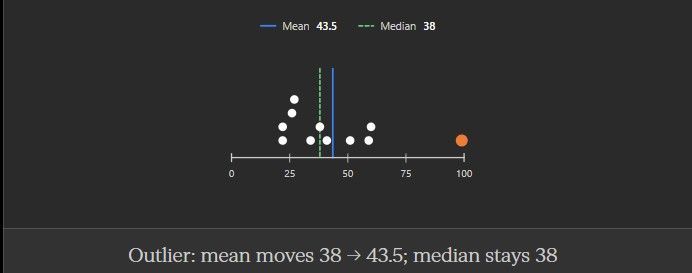
Consider income data.
If most people in a group earn relatively similar amounts but one individual earns substantially more, the mean can move upward even though the majority of observations remain unchanged.
This is why analysts often compare the mean with the median and examine the overall distribution.
Students should therefore learn to ask not only, "What is the average?" but also, "Is the average an appropriate summary of this dataset?"
That question is far more useful in real statistical analysis.
Standard Deviation Helps Explain Variation
Two groups can have exactly the same average while having very different distributions.
One group may have observations clustered closely around the mean.
Another may have observations spread widely across the range.
Standard deviation provides a way to quantify that spread.
This concept appears throughout science, education, economics, quality control, finance, and experimental research.
Understanding variation is especially important because real-world datasets rarely consist of identical observations.
A good statistics education therefore requires students to understand both center and spread.
Sampling Is at the Heart of Real-World Statistics
Researchers frequently want to understand a large population without collecting information from every individual.
Instead, they use samples.
This is where statistical sampling becomes essential.
A well-designed sample can provide useful information about a population while requiring considerably fewer observations than a full census.
But poor sampling can produce misleading results.
Students learning statistics should understand concepts such as:
Population
The complete group a researcher wants to understand.
Sample
The subset of that population actually observed.
Sampling Bias
A systematic problem that causes some members of a population to be overrepresented or underrepresented.
Sampling Variability
The natural differences that occur when different samples are drawn from the same population.
These concepts are foundational to interpreting surveys, polling, research studies, and public datasets.
Modern Data Requires More Than Traditional Calculation
Today's statistical environment increasingly involves large and complex datasets.
Students may encounter data generated by:
- Sensors.
- Websites.
- Scientific experiments.
- Financial transactions.
- Public surveys.
- Mobile devices.
- Social platforms.
- Business systems.
The growing availability of data does not automatically make analysis easier.
More data can introduce more variables, more potential relationships, and more opportunities for misleading conclusions.
Students therefore need strong analytical habits.
They must learn how to determine which information matters, which statistical method is appropriate, and whether the resulting conclusion is supported by the evidence.
Statistical Thinking in Science
Statistics is deeply integrated into scientific research.
Researchers use statistical methods to analyze experimental results, estimate uncertainty, compare groups, evaluate relationships, and determine whether observed differences are likely to represent meaningful patterns.
This makes statistics particularly important for students interested in STEM fields.
Students studying biology, chemistry, environmental science, psychology, engineering, computer science, and other disciplines may encounter statistics throughout their education.
A strong statistics foundation can therefore support academic work far beyond a single course.
Statistics and Educational Data
Statistics also plays a significant role in understanding education itself.
The Census Bureau reported in January 2026 that the share of adults age 25 and older with a bachelor's degree or higher increased in metropolitan areas from 34.2% in the 2015–2019 period to 37.8% in the 2020–2024 period. Approximately 89% of metropolitan areas experienced an increase over that comparison.
Numbers such as these demonstrate why students need to understand the difference between:
- A percentage and a percentage-point change.
- A sample and a population.
- An observed trend and a causal explanation.
- A statistical association and a confirmed relationship.
These distinctions are essential for reading educational statistics correctly.
How Students Can Analyze a Real Statistical Claim
When students encounter a statistical claim online, they can use a simple analytical process.
Start With the Source
Identify who collected or published the data.
A government statistical agency, research institution, survey organization, or private organization may use different methodologies.
Examine the Population
Determine who or what the data represents.
A study of one school district should not automatically be treated as representative of every school district.
Examine the Sample
Look at how observations were selected.
Sampling methodology can influence the reliability of conclusions.
Identify the Statistic
Determine whether the claim uses a mean, median, percentage, rate, correlation, probability, or another measure.
Look for Context
A number without context can be misleading.
Students should examine the time period, comparison group, sample size, and relevant assumptions.
Separate Evidence From Interpretation
The data may show an association, but the explanation for that association may require additional evidence.
This process turns statistics into a practical analytical skill.
Why Online Statistics Tutoring Can Focus on Real Data
Online tutoring is particularly useful for statistics because students can work directly with digital datasets, research examples, statistical exercises, and analytical problems during a lesson.
An online statistics tutor can use real-world examples to connect classroom concepts with the types of data students may encounter in science, business, government, and technology.
Instead of simply asking students to calculate a standard deviation, tutoring can examine why standard deviation matters.
Instead of only calculating a correlation coefficient, students can investigate what the relationship means—and what it does not prove.
This approach connects statistical procedures to actual analytical reasoning.
What Students Should Learn From Modern Statistics
A strong statistics education should leave students capable of doing more than completing textbook exercises.
They should be able to:
- Evaluate the quality of data.
- Understand sampling.
- Interpret statistical summaries.
- Recognize variation.
- Distinguish correlation from causation.
- Understand uncertainty.
- Question unsupported statistical claims.
- Communicate conclusions accurately.
These skills are increasingly relevant because data is becoming part of everyday decision-making.
Why Acewall Scholars Uses a Personalized Online Approach
Acewall Scholars provides online statistics tutoring that can connect academic coursework with practical statistical reasoning.
Students can receive individualized support based on their current course, academic level, and specific areas of difficulty.
Rather than focusing exclusively on memorizing formulas, tutoring can help students understand how statistical concepts function in real situations.
That may include analyzing distributions, interpreting data, understanding sampling, evaluating relationships between variables, and working through statistical problems step by step.
The objective is to make statistical analysis understandable in the context where students are actually expected to use it.
The Role of Statistics in the Data-Driven Future
Statistics is becoming increasingly intertwined with data science, artificial intelligence, scientific research, and public decision-making.
The U.S. Census Bureau's continuing development of data products illustrates this shift. In July 2026, the agency released new HTOPS data tables based on approximately 136,000 households surveyed in March 2026, designed to provide near-real-time information about socioeconomic conditions.
For students, this means statistical literacy is increasingly relevant beyond examinations.
The ability to understand how data is collected, summarized, analyzed, and interpreted is becoming a practical academic and professional skill.
Why an Online Statistics Tutor Should Teach Analysis, Not Just Answers
The most useful statistics tutoring does not stop after a student obtains the correct numerical result.
Students should understand:
What was calculated?
Why was that method selected?
What does the result indicate?
How certain is the conclusion?
What limitations should be considered?
That is the difference between performing a statistical calculation and actually understanding statistics.
Acewall Scholars provides personalized online statistics tutoring focused on developing that deeper understanding through academic instruction, real-world examples, and analytical problem-solving.
For students working toward stronger performance in statistics or preparing for future STEM, data, and research coursework, learning how to interpret information may ultimately be more valuable than memorizing another formula.